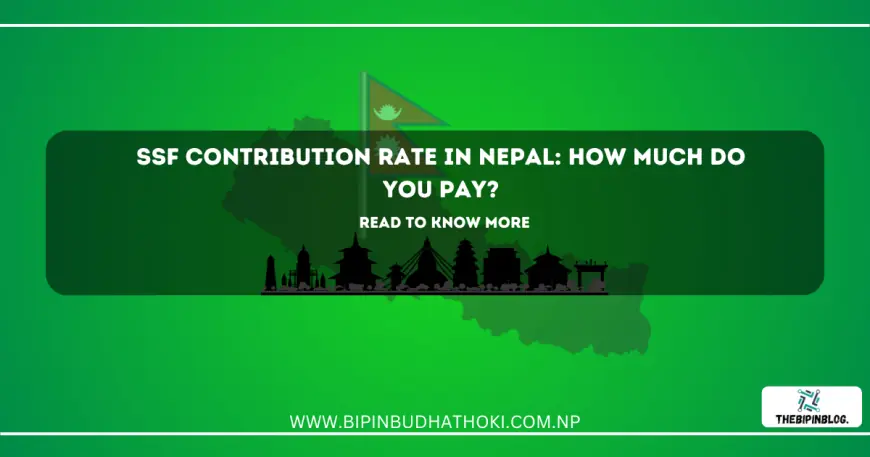
SSF Contribution Rate in Nepal: How Much Do You Pay?
Confused about Social Security Fund (SSF) contributions in Nepal? This guide breaks down the SSF contribution rate for employees and employers, penalties, and how to avoid common mistakes.

Are you wondering how much you or your employer contribute to the Social Security Fund (SSF) in Nepal? Many Nepali workers and employers find the SSF system a bit complex, especially with recent updates. You’re in the right place — this guide will explain everything clearly, including the latest rates and rules.
| Contribution Type | Percentage of Basic Salary | Who Pays It? |
|---|---|---|
| Total SSF Contribution | 31% | Employee (11%) + Employer (20%) |
| Employee’s Share | 11% | Deducted from employee’s basic salary |
| Employer’s Share | 20% | Paid by employer, in addition to salary |
| Contribution Basis | Basic Salary only | Not gross salary, allowances, or bonuses |
| Monthly Deadline | 25th of each Nepali month | For employers to deposit total 31% |
| Late Deposit Penalty | 10% annual interest | On overdue amounts |
Understanding the SSF Contribution Rate
The total Social Security Fund (SSF) contribution is 31% of an employee's basic salary each month. This amount is split between you and your employer. Your employer contributes 20% of your basic salary, which is an additional cost for them and not deducted from your pay. You contribute the remaining 11% of your basic salary, which your employer deducts directly from your monthly earnings.
It’s important to note that this contribution is calculated only on your basic salary. It does not include other parts of your pay like total gross salary, allowances, overtime, or bonuses. This can be a common point of confusion.
How Your Contribution Is Allocated
The 31% total contribution is distributed across various schemes to provide you with comprehensive social security benefits:
- Medical Treatment, Health, and Maternity Protection: 1%
- Accident and Disability Protection: 1.40%
- Dependent Family Protection: 0.27%
- Old-Age Protection: 28.33%
This structure ensures you have coverage for different life events, from health issues to retirement.

Who Is Eligible for SSF?
SSF registration is mandatory for all private-sector employers in Nepal and their employees, as per the Contribution-Based Social Security Act, 2074 (2017 AD). There is no minimum number of employees required for this rule to apply.
As of Fiscal Year 2082/83 (2025/26 AD), SSF enrollment became mandatory for businesses with 10 or more employees. Also, from this same fiscal year, newly appointed government employees are now enrolled under the SSF system instead of the traditional pension and gratuity scheme.
If you are self-employed or work in the informal sector, you can also voluntarily register for SSF. For these categories, you contribute 9.37% of your declared income, which is then matched by a 9.37% government contribution.
Maximum Basic Salary Ceiling
Also starting from FY 2082/83 (2025/26 AD), the maximum basic salary ceiling for SSF contributions was raised. It is now NPR 350,000 per month, up from the previous NPR 300,000.
Employer and Employee Responsibilities
Employers have a crucial role in the SSF process. They must first register their business with the SSF, then enroll their employees within three months of their hiring date. After registration, the employer receives an Employer Registration Number (ERN), and each employee gets an 11-digit Social Security Fund Identification Number (SSFID).
Employers are required to deposit the total 31% contribution (their 20% and your 11%) into the SSF account by the 25th of each Nepali month. This monthly deadline was extended in July 2025 AD to provide more time.
If an employer deposits contributions late, a 10% annual interest charge will be applied to the overdue amount. This is a significant penalty, so timely deposits are essential.
Tax Benefits and Other Schemes
Your SSF contributions are tax-deductible up to NPR 500,000 per year, which can help reduce your taxable income. If you are enrolled in the SSF, you will not have separate Provident Fund or gratuity deductions from your salary, as these benefits are integrated within the SSF contributions.
Common Mistakes to Avoid
Understanding the SSF system can prevent issues later on. Here are some common mistakes and scams to be aware of:
- Calculating SSF on Gross Salary: A frequent error in Nepali payroll is calculating SSF on your total gross salary instead of just your basic salary. Always ensure it's based only on your basic pay.
- Misleading Salary Offers: Some employers might include their 20% SSF contribution when quoting your "gross salary" during job negotiations. This can make your take-home pay seem higher than it is. Always clarify the exact breakdown of your salary in your agreement.
- Employers Not Depositing Contributions: This is a serious issue. If your employer deducts your 11% share but fails to deposit it on time, it's an offense that can lead to fines and imprisonment for them. More importantly, it can jeopardize your ability to claim benefits.
- Not Checking Your Contribution History: You should regularly verify that your contributions are being deposited. You can log in to the official SSF portal (sosys.ssf.gov.np) with your SSFID to check your history.
- Phishing Scams: Be cautious of fake emails, SMS, or calls pretending to be from banks or SSF. Fraudsters try to steal your personal information like User ID, password, or OTP. Always use official websites like ssf.gov.np and never click suspicious links or share your OTP with anyone.
- Fake QR Codes: Scammers sometimes use fake QR codes to trick you into making payments instead of receiving money. Always confirm the recipient's name before scanning and paying.
- Late Employee Enrollment: Employers must enroll employees within three months of hiring. Delays can cause issues for both parties.
- Lack of Evidence for Complaints: If you need to complain about missing contributions, gather sufficient evidence like your payslips and screenshots of your SSF contribution history.
Frequently Asked Questions
What is the SSF contribution percentage in Nepal?
The total SSF contribution is 31% of your basic salary. Your employer pays 20% and you contribute 11% through a deduction from your monthly salary.
Is SSF mandatory for all employees in Nepal?
Yes, SSF registration is mandatory for all private-sector employers and their employees in Nepal. From FY 2082/83 (2025/26 AD), it became mandatory for businesses with 10 or more employees, and also applies to newly appointed government employees.
What is the deadline for SSF contributions in Nepal?
Employers must deposit the total 31% SSF contribution by the 25th of each Nepali month. Late deposits incur a 10% annual interest charge.
How do I check my SSF contribution history?
You can check your SSF contribution history by logging into the official SSF portal at sosys.ssf.gov.np using your 11-digit Social Security Fund Identification Number (SSFID).
Are SSF contributions tax-deductible?
Yes, your SSF contributions are tax-deductible up to NPR 500,000 per year, which can help reduce your overall taxable income.
Does SSF replace Provident Fund and Gratuity?
Yes, if you are enrolled in the SSF, you will not have separate deductions for Provident Fund or gratuity, as these benefits are absorbed and covered by the SSF contribution scheme.
Understanding your SSF contributions is crucial for your financial security in Nepal. By staying informed and verifying your contributions, you can ensure your future benefits are secure. For more financial guidance, check out our other resources like our guide to MeroShare.




![Top 10 Ways to Earn Money Online in Nepal [2025 Edition]](https://bipinbudhathoki.com.np/uploads/images/202504/image_140x98_67f660948dbdd.webp)
![Nagarik App Nepal: Features, Benefits & How to Use It [Complete Guide 2082]](https://bipinbudhathoki.com.np/uploads/images/202508/image_140x98_689826e20cc18.webp)